Origin
Indian subcontinent
An Indian classic
 Board, pieces & cowrie shells
Roots and reach
Indian subcontinent
North and Central India, with historical and cultural connections across other parts of India
Traditional Indian recreation, strategy, and epic literature, particularly the Mahabharata
Related cross-shaped race games found across India, with variations in board design, equipment, and rules
Names and variations
| Name | Region or usage |
|---|---|
| Chausar | Commonly used in North India |
| Chaupar | Widely used alternative spelling, especially in historical and cultural references |
| Chopad | Name used in parts of Rajasthan and western India |
| Chaupad | Regional spelling variant of Chaupar |
| Chaupad / Choupad | Variations in transliteration and pronunciation |
| Pachisi | A closely related traditional Indian board game, but not always identical in rules |
| Chopat | Name associated with related traditional board games in some regions |
Know the game
A quick guide to the players, pace and character of this traditional Indian game.
2–4 players; traditionally played by four players, sometimes in two teams
8 years and above
Approximately 30–90 minutes, depending on the rules and number of players
Traditional Indian race and strategy board game
Easy to learn; requires strategic planning and decision-making
Movement depends on the traditional throwing equipment used, such as cowrie shells or dice
Gather your pieces

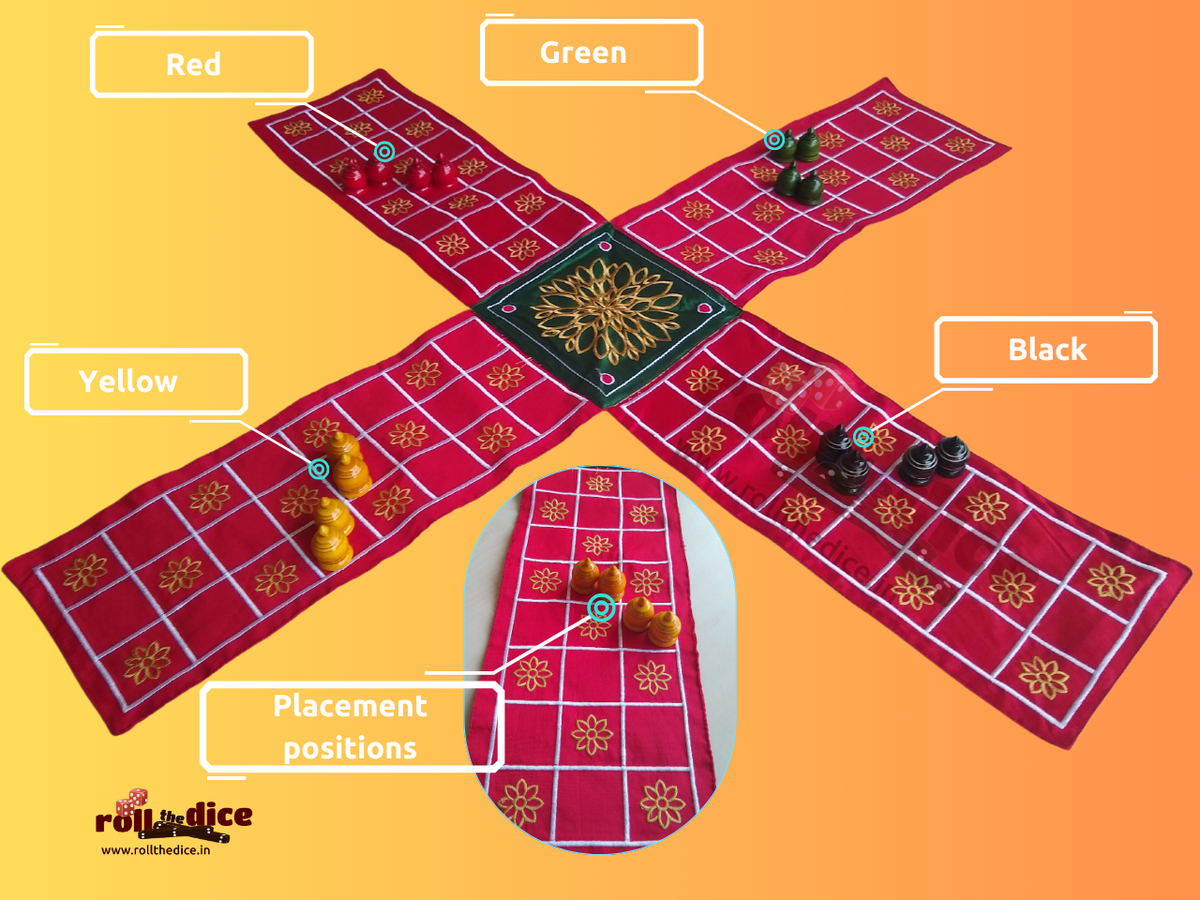
A traditional cross-shaped board, often made of cloth, with marked paths along which the playing pieces move.

Differently coloured or distinguishable pieces represent each player. The number of pieces per player varies by regional version.

Used to determine how far a player's pieces can move. The number of shells and scoring rules depend on the version being played.
The aim of play
The main objective is to move all of a player's pieces around the designated path and bring them safely to the finishing area before the opponents do. Players may also capture opposing pieces, depending on the rules of their version.
A traditional game, simply explained
Learn the foundations of Chausar, from arranging the board to bringing your pawns home. Rules differ across traditions, so use this guide as a starting point.
Spread the cross-shaped Chausar board on a flat surface. Identify the four arms, central area, movement tracks, and home paths.
Four players can participate, with each player choosing a colour. In a common team arrangement, opposite players form a team. Two-player games can also be played with agreed rules.
Give each player four pawns in the traditional 16-piece version. Keep the cowrie shells or long dice ready to determine movement.
In traditional Chaupar, pieces often begin on designated squares on the board rather than all starting off the board. The exact starting squares depend on the version being played.
Each player throws the cowrie shells or dice. Agree on the method for deciding who starts, then play proceeds in turn.
Throw the traditional movement equipment and calculate the permitted move according to the agreed scoring system. Chaupar traditionally uses long dice in some versions, while other related versions use cowrie shells.
Move one or more pawns along the designated track according to the result. Follow the board's direction of movement and any restrictions on which pawns may enter particular paths.
If your pawn lands on an opponent's pawn on a capturable square, the opponent's pawn is sent back to its starting position. Certain safe squares or protected positions may prevent capture, depending on the rules used.
Choose moves carefully to advance your pawns, protect them from capture, and restrict your opponents' progress. In team play, coordinate moves with your partner where the rules permit.
After completing the required route, move your pawns into the designated home path or finishing area. Some traditional rule sets require a pawn to capture an opponent before it can enter its home column.
The winner is the player or team that successfully brings all its pawns to the finishing area first, according to the agreed rules.
Regional traditions
Chausar and Chaupar traditions share family resemblances, yet regional games are related without necessarily being identical. Equipment, movement, and winning conditions may differ by community and version.

Regional variation
Known by names such as Chopat and Chopad. Traditional cloth boards are used in some communities.
Certain documented Rajput and other community traditions associate the game with weddings and festive gatherings. Board dimensions and the number of cowrie shells can vary between communities.

Regional variation
A documented local version is called Choupar or Chopat. Partners sit opposite each other and may move pieces belonging to either partner.
In one recorded variation, a player must capture at least one opposing piece before bringing their pieces into the central finishing area. Special combinations of dice throws can have additional movement effects.

Regional variation
The names Chausar, Chaupar, and Chaupad are used for related forms of the game. Some versions use three elongated dice rather than cowrie shells.
Pieces may begin on predetermined board squares instead of starting from the centre. Rules for finishing a circuit and capturing pieces depend on the particular version.

Regional variation
Related cross-shaped race games have been documented in the region. Historical boards do not always provide enough information to reconstruct their exact playing rules.
Some modern regional forms, including Saripat, are related to this broader family of games, although they should not automatically be treated as identical to Chausar.

Regional variation
Related traditional race games include Pagade in Karnataka. Other regional games, such as Dayakattam and Sokkattan, have their own equipment and rules.
These are useful comparisons for understanding India's regional board-game traditions, but they are distinct games rather than simply alternate rule sets of Chausar.
| Rule Feature | How It May Vary |
|---|---|
| Rule FeaturePlaying Equipment | How It May VaryLong dice or cowrie shells |
| Rule FeatureStarting Positions | How It May VaryPredetermined squares or another locally defined starting area |
| Rule FeatureSafe Squares | How It May VaryPresent, absent, or interpreted differently |
| Rule FeatureCapturing | How It May VaryMay involve different restrictions or special conditions |
| Rule FeatureTeam Play | How It May VaryPartners may cooperate and, in some versions, move each other's pieces |
| Rule FeatureWinning | How It May VaryMay require capturing an opponent before finishing all pieces |
History and heritage
From courtly recreation to familiar home gatherings, Chausar sits within a rich history of Indian board games. The surviving record brings together scholarship, architecture, objects, and literature—each offering a different kind of evidence.
15th–16th centuries
A scholarly study published in 2021 argues that surviving evidence for Chaupar and Pachisi in their recognizable cross-shaped form can be traced to the 15th century. Earlier games may have contributed elements, but their exact relationship remains uncertain.
Mughal period · 1556–1605
During Emperor Akbar’s reign, Chaupar and related games became prominent forms of courtly entertainment. Abu’l Fazl described the game in writing, and the Pachisi courtyard at Fatehpur Sikri remains a notable architectural example of large-scale play.
18th–19th centuries
Surviving playing pieces, dice, and miniature paintings document the game’s continued presence in Indian courtly culture. The Ashmolean Museum holds ornate Chaupar pieces dated to the second half of the 18th century and associated with Rajasthan.
The dice episode in the Mahabharata describes Yudhishthira gambling away his kingdom and wealth, with devastating consequences for the Pandavas. The story is often read as an illustration of uncontrolled gambling, pride, and poor judgement. The epic’s dice game should not automatically be identified as the exact same game as the later documented cross-shaped Chausar.
Chausar was associated with royal courts, while related board games also circulated among ordinary people. Cloth boards, wooden pieces, and traditional dice provided equipment suited to both elaborate courtly entertainment and informal home gatherings.
Calculated movement and unpredictable dice results combine to encourage planning, anticipation, competition, and interaction. The game’s continued presence in traditional gaming collections reflects the importance of play in India’s cultural history.
Chausar and Pachisi belong to a family of Indian cross-shaped race games that influenced or are closely related to later adaptations, including Parcheesi and Ludo. Modern games have simplified or changed traditional mechanics and should not be treated as identical to Chausar.
| Evidence | Historical significance |
|---|---|
| EvidenceWritten descriptions by Abu’l Fazl | Historical significanceDocument the game and its rules during Akbar’s reign |
| EvidencePachisi courtyard at Fatehpur Sikri | Historical significanceDemonstrates large-scale royal play |
| EvidenceSurviving 18th-century game pieces | Historical significanceProvides material evidence of courtly gaming |
| EvidenceLiterary references to dice in Indian epics | Historical significanceEstablish a broader cultural history of dice play, but not necessarily Chausar itself |
Evidence from objects, buildings, written accounts, and literature answers different questions. Literary dice references provide cultural context, but do not by themselves establish the identity or origin of the later documented cross-shaped game.
Discover Chausar
Explore guides and video learning resources, then discover the traditional Chausar set.

Trita – Roll the Dice
₹2,500
A traditional Chausar set from Roll The Dice, with an embroidered mat, coloured wooden pawns, cowrie shells, and dice.
View ProductA practical guide covering equipment, board setup, pawn positions, and cowrie-shell movements. Best for beginners and families.
Read GuideA detailed rulebook covering four-player team play, long dice, movement, captures, combined pawns, and winning conditions.
Read GuideIncludes introductory information, basic gameplay, and strategy suggestions.
Read GuideA learning resource with a video link and written instructions for understanding the traditional board, pieces, and gameplay.
A related demonstration resource with English and Hindi instruction links.