1Starting the Game
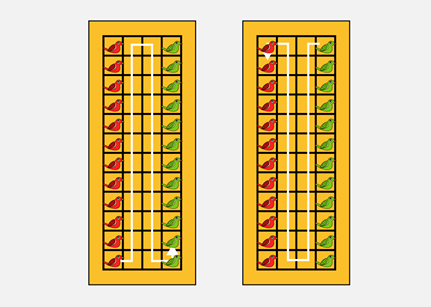
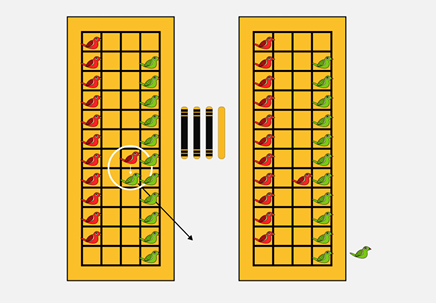
Players take turns throwing the four wooden sticks.
A valid throw determines how many squares a pawn can move.
Taabla appears to be the name of a traditional board game, but the exact game and its rules are difficult to identify from the name alone. Regional games in India often have different names depending on the language and location.
To give you an accurate explanation for your Roll The Dice game guide, could you share a photo of the Taabla board or tell me which state or language the game comes from? This will help me identify the correct game rather than give you incorrect rules or historical details.
| Main name | Taabla |
|---|---|
| Alternate name | Taabulfala |
| Other recorded name | Tabulfale |
| English name | Tablan |
| Regional association | Uttara Kannada and Malnad, Karnataka |
| Other regions | Goa and coastal Maharashtra |
A quick overview of the supplied player, equipment and play setting details.
| Player count | 2 players; can also be played in teams of two |
|---|---|
| Recommended age | 8 years and above (suggested age, not a verified historical rule) |
| Playing duration | Approximately 15–30 minutes (estimated; depends on players and gameplay) |
| Game type | Traditional race and strategy board game |
| Playing environment | Indoor or outdoor on a flat surface |
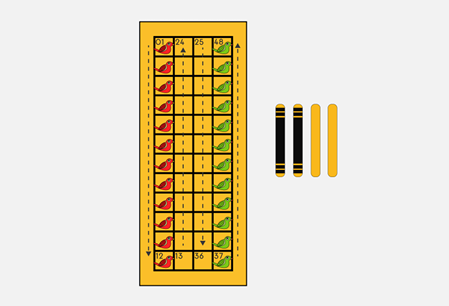
| Board | 4 rows × 12 squares, making 48 squares |
| Playing pieces | 24 bird-shaped pawns — 12 red and 12 green |
| Dice | 4 semi-cylindrical wooden throwing sticks, called Taabla Kocchu |
| Other materials | Instruction sheet |
Roll the Dice · Game guide

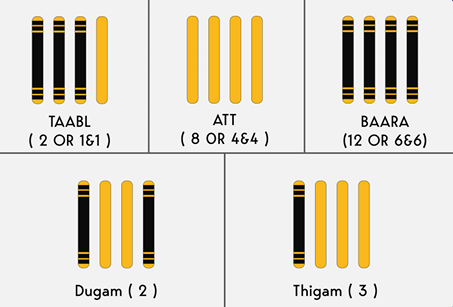
The throw outcomes and their movement rules are shown below.
| Throw | Score | Rule |
|---|---|---|
| Tabl | 2 | May split into 1 + 1; throw again |
| Eight | 8 | May split into 4 + 4; throw again |
| Twelve | 12 | May split into 6 + 6; throw again |
| Dogam | 2 | Move 2 squares without splitting |
| Tigam | 3 | Move 3 squares without splitting |
| Invalid throw | No move | Turn passes to the opponent |


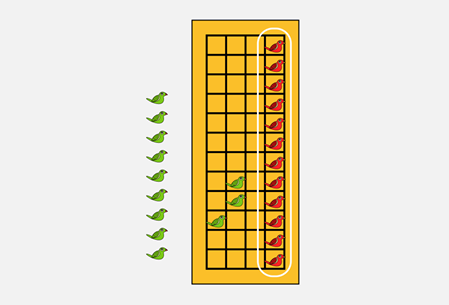
The game ends when no further useful moves can be made. The player who locks the greatest number of pawns in the opponent's home row wins. Capturing opposing pawns helps players gain an advantage.
Traditional board-game guide
| Region / Version | Regional Variations |
|---|---|
| Goa – Tabul Phale | Traditionally played on a decorated wooden board with 48 squares, 12 pieces per player and four throwing sticks. The board is associated with the Chitari decorative-art tradition. |
| Karnataka – Tablan / Taabla | A cloth board with a 12 × 4 grid is documented in a Karnataka version. Throwing-stick scores and their use differ from the Goan version. |
| Maharashtra – Tabalphal | Associated with the Sawantwadi region, where the tradition of decorated wooden boards continues. |
| Konkan regional tradition | Players traditionally use wooden throwing sticks, and movement depends on how the sticks land. Local conventions may vary. |
Recorded traces
A historical Tabul Phale board from Goa is documented in the Ancient Indian Boardgames digital archive, with a record associating it with the collection of Bagore Ki Haveli Museum in Udaipur.
Game historian R. C. Bell recorded that Tablan was still being played in villages in Mysore, southwestern India, during the second half of the 20th century. A 1979 ethnographic record describes its board, pieces and four throwing sticks.
A Marathi cultural encyclopaedia describes Tabul Fale as a traditional sitting game of the Konkan region.
A living heritage
| Aspect | Historical and Cultural Significance |
|---|---|
| Regional heritage | Associated with traditional recreational life in Goa, the Konkan region and parts of southern India. |
| Artisan craftsmanship | Goan boards are associated with Chitari decorative art, practised by artisans in Cuncolim, Goa. |
| Family recreation | The game provided an opportunity for two players to enjoy friendly competition and strategic thinking. |
| Traditional materials | Wooden boards, coloured playing pieces and hand-painted throwing sticks reflect traditional craft practices. |
| Cultural preservation | Museums, heritage archives and traditional-game initiatives document the game and help introduce it to newer generations. |
Historical significance
Taabla is significant because it connects traditional Indian strategy games with regional craftsmanship and community heritage. Its four-stick dice system and race-like movement make it an interesting example of India's diverse board-game traditions.
The game's exact origin date remains uncertain. Although a Tabul Phale board is documented as an 18th-century artefact, this does not establish when the game was first invented. Researchers have also discussed possible relationships with other games, but its precise historical lineage has not been conclusively established.
ROLL THE DICE · TAABLA SET
Rs. 1,100.00
Listed price; availability may change.
Learn the setup, throwing-stick scores, movement, captures and winning objective.
Source: Roll The Dice