Mental Calculation
Builds mental calculation through counting and distributing seeds.

A Traditional Game from Karnataka
Channe Mane is a traditional seed-and-pit board game from Karnataka, India, combining simple gameplay with thoughtful strategy and mental calculation.
Played on a wooden board featuring a series of small pits, the game uses seeds or small counters that are distributed between the pits according to established rules. Players carefully plan each move, count the seeds, and anticipate possible moves in order to collect more counters and gain an advantage.
More than a recreational game, Channe Mane represents a traditional form of learning through play. Its straightforward setup encourages players to develop counting skills, concentration, memory, logical thinking, and strategic decision-making while enjoying a face-to-face gaming experience.
Traditionally played within families and communities, the game has been passed down through generations, making it an important part of Karnataka's traditional play culture.

“Every seed counts. Every move matters.”
Builds mental calculation through counting and distributing seeds.
Encourages strategic thinking by requiring players to plan ahead.
Improves concentration and observation through continuous gameplay.
Creates meaningful interaction through face-to-face play.
Connects generations by bringing traditional games back to the family table.
Preserves cultural heritage by introducing younger generations to Karnataka’s traditional games.
Play, learn and gather
Channe Mane is more than a board game. It is a connection between traditional knowledge, family interaction, and learning through play.
In a world increasingly dominated by digital entertainment, traditional games like Channe Mane offer an opportunity to slow down, gather around a table, and experience the simple joy of playing together.

Channe Mane is a traditional mancala-style board game associated with Karnataka, India. It is particularly documented in Coastal Karnataka/Tulu Nadu, while related forms and names are found across different parts of Karnataka and neighboring South Indian states.
Rediscover a traditional game. Learn its strategy. Share it with the next generation.
Explore Channe Mane | Aliguli ManeHERITAGE • CULTURE • TRADITION
From Chenne Mane in Coastal Karnataka to Pallanguzhi in Tamil Nadu and Vamana Guntalu in Andhra Pradesh and Telangana, the game reflects a wider South Indian tradition of pit-and-seed board games.
These names refer to closely related regional forms of the mancala family of sowing-and-capturing games, although the rules, starting number of seeds, and playing traditions can vary from one region to another.
| REGION | REGIONAL NAME |
|---|---|
| Karnataka | Channe Mane / Chenne Mane |
| Karnataka | Ali Guli Mane / Alaguli Mane |
| Tulu Nadu / Coastal Karnataka | Chenne Mane / Chenna Maaney |
| North Karnataka | Akal Patta |
| Tamil Nadu | Pallanguzhi / Pallankuli |
| Andhra Pradesh & Telangana | Vamana Guntalu |
| Maharashtra | Satkoli / Sat-gol |
The name 'Channe Mane' is strongly associated with Karnataka's traditional version of the game. Mane refers to the board, while the game is played using seeds, shells, or other small counters placed in its pits.
Historical and ethnographic documentation records Chenne Mane as a game played across Karnataka, with several local variants.
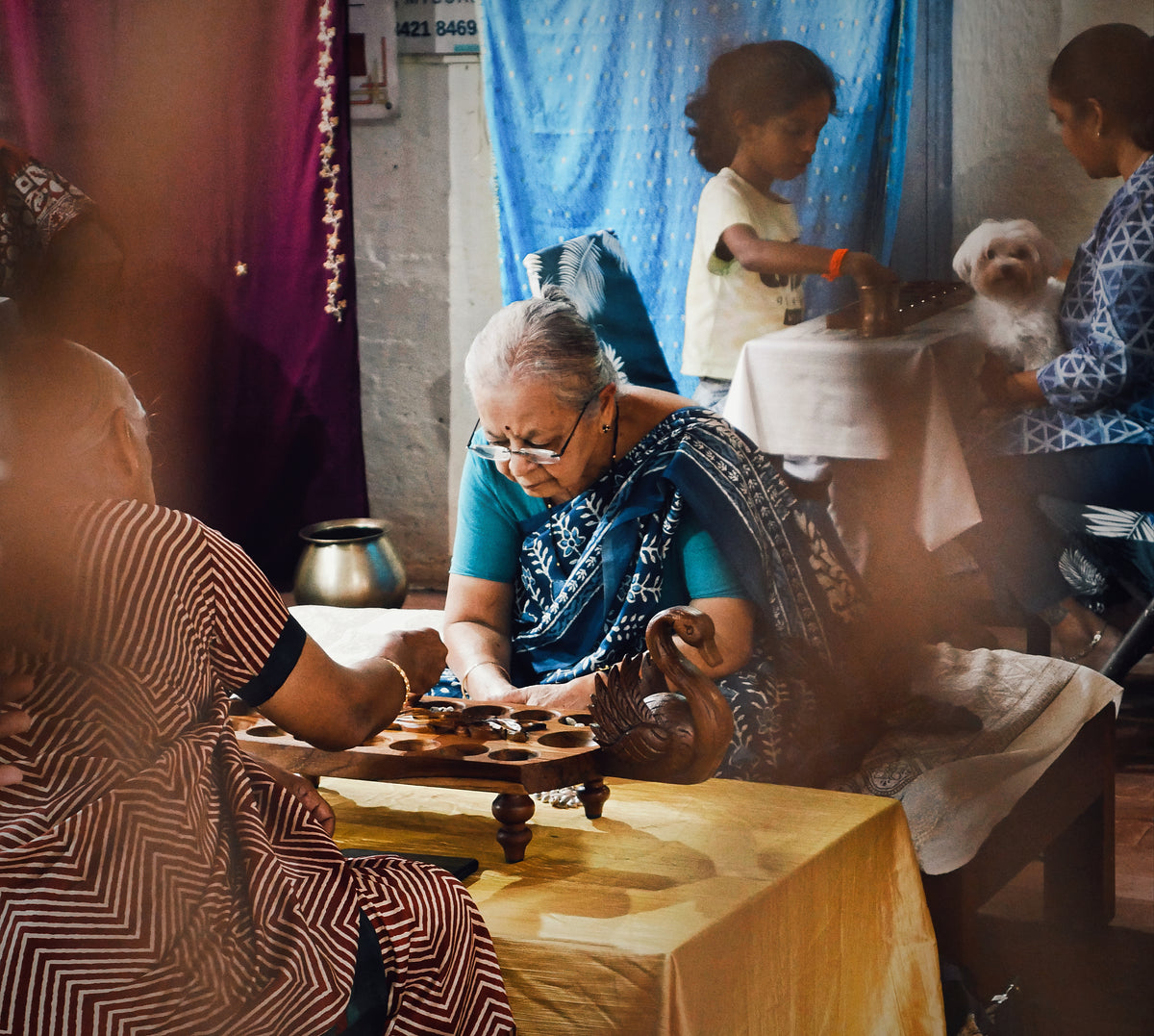
From one region to another, the names may change, but the tradition of gathering around a board and playing together continues.
Bring home a traditional game from Karnataka and create new memories around the family table.
KNOW YOUR GAME
Everything you need to know before gathering around the board.
PLAYERS
2 Players
RECOMMENDED AGE
3+
DURATION
Approx. 20–60 minutes*
BOARD
Wooden board with 14 pits
COUNTERS
Seeds, shells or small playing pieces
GAME TYPE
Traditional strategy & counting game
| FEATURE | CHANNE MANE |
|---|---|
| Players | 2 players |
| Recommended Age | 3+ |
| Duration | Approx. 20–60 minutes* |
| Board | Wooden board with 14 pits |
| Counters | Seeds, shells or small playing pieces |
| Game Type | Traditional strategy & counting game |
| Region | Karnataka, India |

Rooted in Karnataka's traditional play culture, Channe Mane brings counting, strategy, and face-to-face play together around a wooden board.
Bring home Channe Mane and rediscover the joy of traditional play.
Channe Mane is easy to set up, but mastering the game requires careful counting, observation, and strategy.
The following guide presents a traditional two-player format. Rules may vary across different regions of Karnataka.

Place the Channe Mane board between two players.

The first player chooses any pit on their side and picks up all the seeds from that pit.
The player then sows the seeds one at a time into the following pits in sequence.

If the final seed lands in a pit that already contains seeds, the player picks up all the seeds from that pit and continues sowing.
This process continues until the move reaches a pit where the required condition for the turn is met.
Players must carefully count the seeds in each pit.
In the documented Channe Mane variation, forming a group of four seeds creates an opportunity for capture, known as Karu.
The timing of the capture is important. If the number of seeds increases beyond the required count before the capture is made, that opportunity may be lost.
HOW TO PLAY · CONTINUED

5CREATE A KATTIDA MANE
A special four-seed position can become a Kattida Mane.
Once established, the pit is treated as a protected or closed position and is not supplied with additional seeds during subsequent play, according to this traditional variation.

6WINNING THE GAME
Players continue taking turns, sowing seeds and creating Kattida Mane positions.
At the end of the game, the player with more Kattida Mane is declared the winner in this documented variation.
The beauty of Channe Mane lies in its simplicity: a handful of seeds, a wooden board, and a game of thoughtful strategy.
Count carefully. Plan ahead. Make every move count.

Bring home a traditional game from Karnataka and start creating memories around the family table.
REGIONAL TRADITIONS
Channe Mane and related Chenne Mane traditions have been played in different regions, with variations in seed distribution, capturing, strategy, and local rules.
| REGION / TRADITION | VARIATION | KEY DIFFERENCE |
|---|---|---|
| Southern Karnataka | Buleperga | A recognised regional form of Chenne Mane with its own local rules. |
| Northern Karnataka | Karu Baruva | A regional form in which the rules and strategy differ from southern versions. |
| Tulu Nadu / Coastal Karnataka | Chenne Mane Ata | Multiple local forms are traditionally played, with variations in seed distribution and capturing. |
| Tulu Nadu | Mule Ata | Uses 7 seeds and is associated with creating 'houses' at the corners of the board. |
| Tulu Nadu | Sainya Mukhya | Uses 4 seeds, with variations in the way the game is played. |
| Tulu Nadu | Kanji Paduna Gobbu | Played with 4 seeds and has its own local objective and rules. |
Buleperga
Key differenceA recognised regional form of Chenne Mane with its own local rules.
Karu Baruva
Key differenceA regional form in which the rules and strategy differ from southern versions.
Chenne Mane Ata
Key differenceMultiple local forms are traditionally played, with variations in seed distribution and capturing.
Mule Ata
Key differenceUses 7 seeds and is associated with creating 'houses' at the corners of the board.
Sainya Mukhya
Key differenceUses 4 seeds, with variations in the way the game is played.
Kanji Paduna Gobbu
Key differencePlayed with 4 seeds and has its own local objective and rules.
THE SEEDS CAN CHANGE
One of the most noticeable differences between regional versions is the number of seeds placed in each pit at the beginning.
Documented versions of the wider Ali Guli Mane/Chenne Mane tradition use different starting quantities, including 4, 5, 7, and even 12 pieces per pit. These are examples of documented starting quantities across related regional traditions, not mandatory rules for every Channe Mane game.
Documented for Cenne Mane and some Tulu Nadu variants.
Commonly documented in Karnataka versions, including Southern Karnataka.
Used in some Tulu Nadu variations such as Mule Ata.
Some related regional mancala forms use different starting counts.
Channe Mane, also known as Chenne Mane, is a traditional board game documented across Karnataka, with particularly strong cultural associations with Tulu Nadu and Dakshina Kannada. It belongs to the wider family of mancala-style sowing and counting games, in which players distribute seeds or counters among a series of pits. The Ancient Indian Boardgames digital archive documents Channe Mane as having multiple regional names, variants, and rule systems across Karnataka.

Traditional Channe Mane boards were generally made from wood, although historical documentation also records versions played using holes made in stone slabs or directly in the ground. Seeds from locally available plants—including tamarind and coral-tree seeds—were commonly used as playing pieces. This reflects how traditional games often made use of materials readily available within the local environment.
The Manjusha Museum in Dharmasthala preserves a 20th-century Chennemane, documenting the wooden board and locally sourced seeds used with it. The museum describes the game as an important part of the cultural heritage of Tulunadu.

In Tulu Nadu, Chennemane was traditionally associated with the Aati month, the monsoon period. During this season, agricultural activity was reduced by heavy rainfall, creating more opportunities for indoor activities and family games. Traditional terminology used in the game also contains references connected with agriculture, sowing, and harvest, reflecting the close relationship between the game and rural life.

Chennemane was more than entertainment. Historical and cultural documentation describes it as a social and family activity, often played for extended periods and across generations. The Manjusha Museum records the game as suitable for a very wide age range and highlights its role in family interaction.
A 2020 study specifically examining Chennemane in Dakshina Kannada investigated its historical development, playing forms, cultural values, and contribution to the community, based on interviews and field research involving local participants and folklore experts.

Historical Evidence & Cultural Context — Part 2
The game naturally involves counting, calculation, concentration, observation, and planning. Contemporary accounts of the tradition describe these skills as part of its educational and recreational value, while also emphasizing its role in maintaining interaction between younger and older generations.
Counting and distributing seeds
Thinking through possible moves
Maintaining focus during play
Watching the board and anticipating moves
Thinking ahead before making a move
Documentation & preservation
Chenne Mane is now also part of efforts to document and preserve Karnataka's traditional games. The Indira Gandhi National Centre for the Arts (IGNCA) has documented Chennemane among the traditional folk games of Dakshina Kannada and noted the importance of recording such traditions as they face pressures from modernization, formal education, and urbanization.
Reference: Indira Gandhi National Centre for the Arts (IGNCA)
A tradition carried forward
Channe Mane brings together play, mathematics, agriculture, family traditions, and local craftsmanship. Its simple wooden board and handful of seeds represent a form of traditional knowledge that was passed through everyday play rather than formal instruction.
From the hands of one generation to the next, Channe Mane keeps traditional play—and the stories surrounding it—alive.

Bring a piece of Karnataka's traditional play culture to your family table.
Explore the rules, watch the traditional game in action, and bring Channe Mane home for your own family table.
Explore a step-by-step guide to Channe Mane / Alaguli Mane, covering the board setup, seed distribution, gameplay, capturing, winning conditions, and regional variations.
Learn How to PlayA video can make the traditional sowing and counting process much easier to understand.
Watch a step-by-step video guide to understanding the traditional sowing and counting process.
For a cultural perspective rather than a rules tutorial, this video documents the traditional game of Tulunadu and people's memories and experiences with it.
For customers who want to experience the game themselves, a traditional Channe Mane / Alaguli Mane set is available with a wooden 14-pit board and playing counters.
The Roll The Dice set uses a beech-wood board crafted by Channapatna artisans, along with 80 small cowrie shells and six marker stones.